Introduction
Building a production-grade trading system in Python requires bridging the gap between Python’s ease of development and the demanding latency requirements of financial markets. Aeron, developed by Real Logic, has become the gold standard for ultra-low-latency messaging in trading systems because it eliminates garbage collection pauses, provides guaranteed message delivery, and operates with microsecond-level latency.
This guide walks you through using Aeron with Python to build a complete trading platform architecture, covering market data ingestion, order execution, and real-time analytics—all with Python’s productivity and Aeron’s performance.
What You’ll Learn
- Aeron fundamentals and why it’s ideal for trading platforms
- Setting up Aeron with Python bindings and C extensions
- Architecture patterns for market data, order execution, and position management
- Real Python code examples for trading logic
- Performance optimization strategies for Python
- Deployment best practices and operational considerations
Prerequisites
- Solid Python programming experience (3.8+)
- Familiarity with trading concepts (orders, execution, risk)
- Understanding of asyncio and event-driven architecture
- Linux system administration basics
- Networking fundamentals (TCP, UDP, multicast)
Part 1: Architecture Overview
Why Aeron for Trading Systems?
The Problem with Traditional Messaging
- Message brokers (Kafka, RabbitMQ) add latency through persistence layers
- JVM garbage collection pauses can cause 10-100ms stalls (unacceptable in trading)
- Network stacks waste CPU cycles on context switching
- No guaranteed message ordering under failure conditions
Aeron’s Solution
- Zero-copy messaging - Messages bypass kernel, direct to shared memory
- GC-free operation - Pre-allocated buffers eliminate garbage collection
- Sub-microsecond latency - Typical p99 latencies: 100-500 nanoseconds
- Reliable delivery - Lost message recovery without replay storms
- Flow control - Back-pressure handling without dropping messages
System Architecture
┌─────────────────────────────────────────────────────────┐
│                                                         │
│  MARKET DATA SOURCE (Exchange Feed)                    │
│              ↓                                          │
│  ┌─────────────────────────────────────────────────┐  │
│  │  Market Data Ingestion (Aeron Publisher)        │  │
│  │  - Multicast from exchange                      │  │
│  │  - Deduplication & validation                   │  │
│  │  └─→ Order Book Reconstruction                  │  │
│  └─────────────────────────────────────────────────┘  │
│              ↓                                          │
│  ┌─────────────────────────────────────────────────┐  │
│  │  Trading Engine (Aeron Subscriber/Publisher)   │  │
│  │  - Strategy execution                           │  │
│  │  - Real-time risk checks                        │  │
│  │  - Order generation                             │  │
│  └─────────────────────────────────────────────────┘  │
│              ↓                                          │
│  ┌─────────────────────────────────────────────────┐  │
│  │  Order Execution (Aeron Publisher)              │  │
│  │  - Order formatting (FIX/native)                │  │
│  │  - Execution routing                            │  │
│  │  - Latency tracking                             │  │
│  └─────────────────────────────────────────────────┘  │
│              ↓                                          │
│  EXCHANGE/BROKER CONNECTION                           │
│                                                         │
└─────────────────────────────────────────────────────────┘

Parallel Data Flow:
├─ Position Management (in-memory)
├─ Risk Analytics (real-time P&L, Greeks)
├─ Audit Log (persistent, for compliance)
└─ Monitoring & Metrics (Micrometer/Prometheus)
Key Design Principles
1. Separate Concerns with Aeron Channels
- Market Data Channel: Broadcasts price updates (multicast or unicast)
- Command Channel: Trading engine → execution (request-response with Aeron)
- Execution Channel: Orders to exchange (reliable, ordered)
- Analytics Channel: Real-time P&L and risk metrics
2. Memory Isolation
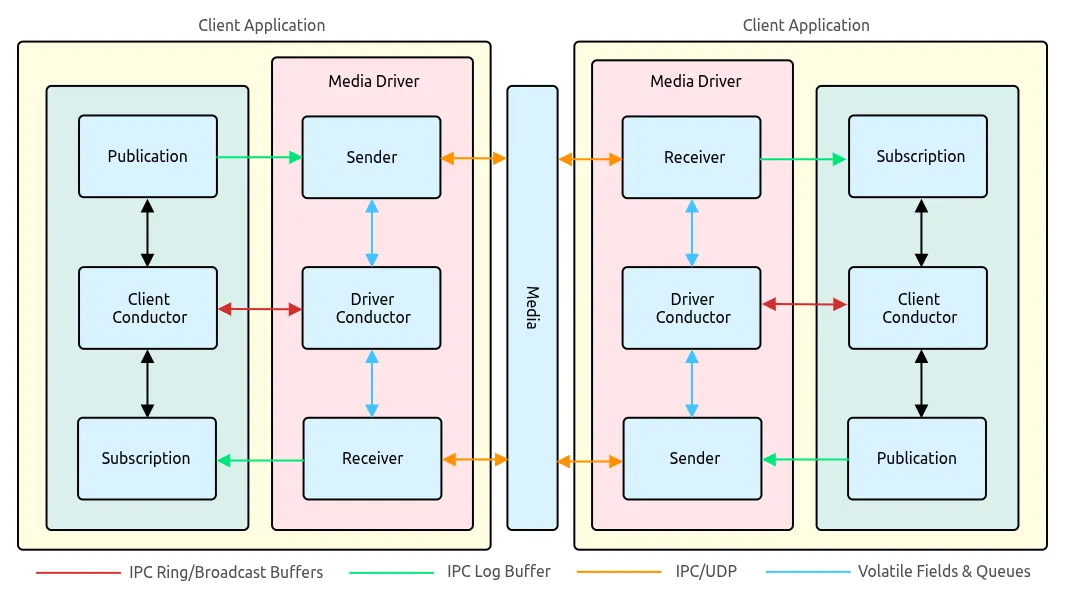
- Use separate Aeron Media Drivers for isolated failures
- Dedicate CPU cores to critical message processing
- Pre-allocate all buffers (no runtime allocation)
3. Deterministic Performance
- Lock memory pages to prevent paging
- Pin threads to CPU cores
- Disable C-state sleeping in CPU governor
- Use NUMA-aware memory allocation
Part 2: Setting Up Aeron with Python
Installation & Dependencies
Option 1: Using Aeron via Python Bindings (Recommended)
# Install Aeron Python wrapper
pip install aeron-python

# Or build from source for latest features
git clone https://github.com/real-logic/aeron.git
cd aeron/aeron-samples/python
pip install -e .
Option 2: Using Aeron C Extension (Lowest Latency)
# Install C bindings for maximum performance
pip install aeron-c-ext

# Requires Aeron C library
sudo apt-get install aeron-dev
Dependencies for Trading Platform
# Core dependencies
pip install numpy pandas

# Async and concurrency
pip install aiofiles asyncio-contextmanager

# Data serialization
pip install msgpack protobuf

# Monitoring and metrics
pip install prometheus-client

# Optional: for order book management
pip install sortedcontainers
Project Structure
trading_platform/
├── config/
│   ├── aeron.conf
│   └── trading_config.yaml
├── platform/
│   ├── __init__.py
│   ├── market_data.py       # Market data ingestion
│   ├── order_book.py        # Order book reconstruction
│   ├── strategy_engine.py    # Trading strategy execution
│   ├── order_executor.py     # Order management
│   └── position_manager.py   # Position tracking
├── monitoring/
│   ├── metrics.py           # Prometheus metrics
│   └── logger.py            # Structured logging
├── main.py                  # Entry point
└── requirements.txt
Aeron Configuration File
Create config/aeron.conf:
# Media Driver Configuration for Ultra-Low-Latency Trading
AERON_DRIVER_TERMINATION_MODE=LINGER
AERON_DRIVER_LINGER_TIMEOUT_NS=5000000000
AERON_DRIVER_THREADING_MODE=DEDICATED
AERON_DRIVER_RECEIVER_THREAD_AFFINITY=1
AERON_DRIVER_SENDER_THREAD_AFFINITY=2
AERON_DRIVER_CONDUCTOR_THREAD_AFFINITY=3

# Network configuration
AERON_UDP_CHANNEL_SEND_BUFFER_LENGTH=2097152
AERON_UDP_CHANNEL_RECV_BUFFER_LENGTH=2097152
AERON_INITIAL_WINDOW_LENGTH=16777216
AERON_FLOW_CONTROL_STRATEGY=cubic

# Memory configuration
AERON_COUNTERS_BUFFER_LENGTH=33554432
AERON_TERM_BUFFER_LENGTH=536870912
Basic Aeron Initialization in Python
# platform/__init__.py
import aeron
from typing import Optional

class AeronContext:
    """Singleton context for Aeron Media Driver"""
    _instance: Optional['AeronContext'] = None

    def __init__(self, config_dir: str = "config"):
        self.context = aeron.AeronContext()
        self.context.concurrency_level = 3
        self.context.term_buffer_length = 536870912  # 512MB
        self.context.initial_window_length = 16777216  # 16MB

    @classmethod
    def get_instance(cls, config_dir: str = "config") -> 'AeronContext':
        if cls._instance is None:
            cls._instance = AeronContext(config_dir)
        return cls._instance

    def create_aeron(self) -> aeron.Aeron:
        return aeron.Aeron.connect(self.context)
Launching the Trading Platform
Create main.py:
import asyncio
import logging
from platform import AeronContext
from platform.market_data import MarketDataSubscriber
from platform.strategy_engine import StrategyEngine
from platform.order_executor import OrderExecutor
from monitoring.metrics import MetricsCollector

logging.basicConfig(level=logging.INFO)
logger = logging.getLogger(__name__)

async def main():
    # Initialize Aeron context
    aeron_ctx = AeronContext.get_instance()
    aeron_client = aeron_ctx.create_aeron()

    # Initialize components
    metrics = MetricsCollector()
    market_data = MarketDataSubscriber(aeron_client, metrics)
    strategy = StrategyEngine(metrics)
    executor = OrderExecutor(aeron_client, metrics)

    logger.info("Trading platform initialized")

    try:
        # Run concurrent tasks
        await asyncio.gather(
            market_data.subscribe(),
            strategy.run(market_data),
            executor.run(),
            return_exceptions=False
        )
    except KeyboardInterrupt:
        logger.info("Shutting down gracefully...")
    finally:
        aeron_client.close()
        logger.info("Platform shutdown complete")

if __name__ == "__main__":
    asyncio.run(main())
Part 3: Market Data Ingestion in Python
Market Data Subscriber
Create platform/market_data.py:
import aeron
import struct
import asyncio
import time
from dataclasses import dataclass
from typing import Callable, Optional
from monitoring.metrics import MetricsCollector

@dataclass
class MarketUpdate:
    symbol: str
    bid: float
    ask: float
    bid_size: int
    ask_size: int
    timestamp: int  # nanoseconds
    sequence: int

class MarketDataSubscriber:
    def __init__(self, aeron_client: aeron.Aeron, metrics: MetricsCollector):
        self.aeron = aeron_client
        self.metrics = metrics

        # Subscribe to market data channel
        self.subscription = aeron_client.add_subscription(
            "aeron:udp?endpoint=224.0.1.1:40123|interface=eth0",
            stream_id=10
        )

        # Order book state
        self.order_books = {}
        self.last_update_time = 0

        # Callbacks for subscribers
        self._handlers = []

    def subscribe(self, handler: Callable[[MarketUpdate], None]):
        """Register a handler for market updates"""
        self._handlers.append(handler)

    async def run(self):
        """Main loop for ingesting market data"""
        # Wait for subscription to be ready
        while not self.subscription.is_connected():
            await asyncio.sleep(0.001)

        print("Listening for market data...")

        while True:
            try:
                # Poll for messages (non-blocking)
                fragment_handler = self._create_fragment_handler()
                self.subscription.poll(fragment_handler, limit=10)

                # Yield to event loop
                await asyncio.sleep(0.00001)  # 10 microseconds

            except Exception as e:
                print(f"Error in market data subscriber: {e}")
                await asyncio.sleep(0.1)

    def _create_fragment_handler(self):
        """Create handler for incoming messages"""
        def handle_fragment(buffer, offset, length, header):
            try:
                # Parse message (example: fixed binary format)
                # Format: symbol(4), bid(8), ask(8), bid_size(8), ask_size(8), seq(8)
                msg_data = buffer[offset:offset+length]

                symbol = msg_data[0:4].decode('ascii')
                bid = struct.unpack('!d', msg_data[4:12])[0]
                ask = struct.unpack('!d', msg_data[12:20])[0]
                bid_size = struct.unpack('!Q', msg_data[20:28])[0]
                ask_size = struct.unpack('!Q', msg_data[28:36])[0]
                sequence = struct.unpack('!Q', msg_data[36:44])[0]
                timestamp = header.reserved_value  # Aeron provides timestamp

                update = MarketUpdate(
                    symbol=symbol.strip('\x00'),
                    bid=bid,
                    ask=ask,
                    bid_size=bid_size,
                    ask_size=ask_size,
                    timestamp=timestamp,
                    sequence=sequence
                )

                # Validate and process
                if self._validate_update(update):
                    self._process_update(update)

                    # Record latency
                    latency_ns = time.time_ns() - update.timestamp
                    self.metrics.record_latency('market_data_ingestion', latency_ns)

                    # Notify handlers
                    for handler in self._handlers:
                        handler(update)

            except Exception as e:
                print(f"Error processing market data: {e}")
                self.metrics.increment('errors_market_data')

        return handle_fragment

    def _validate_update(self, update: MarketUpdate) -> bool:
        """Validate market data sanity"""
        # Check for data sanity
        if update.bid <= 0 or update.ask <= 0:
            return False

        if update.bid >= update.ask:
            return False

        if update.bid_size < 0 or update.ask_size < 0:
            return False

        return True

    def _process_update(self, update: MarketUpdate):
        """Update order book state"""
        if update.symbol not in self.order_books:
            self.order_books[update.symbol] = OrderBookState(update.symbol)

        book = self.order_books[update.symbol]
        book.update(update.bid, update.ask, update.bid_size, update.ask_size)
        self.last_update_time = update.timestamp

    def get_order_book(self, symbol: str) -> Optional['OrderBookState']:
        return self.order_books.get(symbol)

class OrderBookState:
    """In-memory order book representation"""
    def __init__(self, symbol: str):
        self.symbol = symbol
        self.bid = 0.0
        self.ask = 0.0
        self.bid_size = 0
        self.ask_size = 0
        self.mid_price = 0.0
        self.spread = 0.0

    def update(self, bid: float, ask: float, bid_size: int, ask_size: int):
        self.bid = bid
        self.ask = ask
        self.bid_size = bid_size
        self.ask_size = ask_size
        self.mid_price = (bid + ask) / 2.0
        self.spread = ask - bid

    def to_dict(self):
        return {
            'symbol': self.symbol,
            'bid': self.bid,
            'ask': self.ask,
            'bid_size': self.bid_size,
            'ask_size': self.ask_size,
            'mid': self.mid_price,
            'spread': self.spread
        }
Part 4: Order Execution Engine in Python
Trading Strategy Base Class
Create platform/strategy_engine.py:
import asyncio
from abc import ABC, abstractmethod
from dataclasses import dataclass
from enum import Enum
from typing import Optional
from monitoring.metrics import MetricsCollector
from platform.market_data import MarketDataSubscriber, OrderBookState, MarketUpdate

class OrderSide(Enum):
    BUY = 1
    SELL = -1

@dataclass
class Order:
    symbol: str
    side: OrderSide
    price: float
    size: int
    order_id: int
    timestamp: int

class TradingStrategy(ABC):
    """Base class for trading strategies"""

    def __init__(self, position_manager, order_publisher, metrics: MetricsCollector):
        self.position_manager = position_manager
        self.order_publisher = order_publisher
        self.metrics = metrics

    @abstractmethod
    async def on_market_update(self, update: MarketUpdate, order_book: OrderBookState):
        """Called when market data arrives"""
        pass

    @abstractmethod
    async def on_order_fill(self, order: Order, fill_price: float, fill_size: int):
        """Called when an order is filled"""
        pass

class MomentumStrategy(TradingStrategy):
    """Example: Simple momentum-based strategy"""

    def __init__(self, position_manager, order_publisher, metrics):
        super().__init__(position_manager, order_publisher, metrics)
        self.price_history = {}
        self.window_size = 10
        self.momentum_threshold = 0.005  # 0.5% movement
        self.last_prices = {}

    async def on_market_update(self, update: MarketUpdate, order_book: OrderBookState):
        """React to market updates"""

        # Calculate momentum
        if update.symbol not in self.last_prices:
            self.last_prices[update.symbol] = order_book.mid_price

        last_price = self.last_prices[update.symbol]
        momentum = (order_book.mid_price - last_price) / last_price
        self.last_prices[update.symbol] = order_book.mid_price

        # Record metrics
        self.metrics.gauge('momentum', momentum, labels={'symbol': update.symbol})

        # Generate signals
        if momentum > self.momentum_threshold:
            await self._send_buy_signal(update, order_book)
        elif momentum < -self.momentum_threshold:
            await self._send_sell_signal(update, order_book)

    async def _send_buy_signal(self, update: MarketUpdate, order_book: OrderBookState):
        """Send buy order if risk checks pass"""

        # Risk management: check position limits
        current_position = await self.position_manager.get_position(update.symbol)

        if current_position is None or current_position.quantity < 1000:
            # Create order
            order = Order(
                symbol=update.symbol,
                side=OrderSide.BUY,
                price=order_book.ask,
                size=100,
                order_id=await self._generate_order_id(),
                timestamp=update.timestamp
            )

            # Send order
            success = await self.order_publisher.publish_order(order)

            if success:
                await self.position_manager.add_pending_order(order)
                self.metrics.increment('orders_sent', labels={'side': 'BUY'})

    async def _send_sell_signal(self, update: MarketUpdate, order_book: OrderBookState):
        """Send sell order if risk checks pass"""

        current_position = await self.position_manager.get_position(update.symbol)

        if current_position and current_position.quantity > 0:
            order = Order(
                symbol=update.symbol,
                side=OrderSide.SELL,
                price=order_book.bid,
                size=min(100, current_position.quantity),
                order_id=await self._generate_order_id(),
                timestamp=update.timestamp
            )

            success = await self.order_publisher.publish_order(order)

            if success:
                await self.position_manager.add_pending_order(order)
                self.metrics.increment('orders_sent', labels={'side': 'SELL'})

    async def on_order_fill(self, order: Order, fill_price: float, fill_size: int):
        """Update position when order fills"""
        await self.position_manager.confirm_order(order, fill_price, fill_size)

    async def _generate_order_id(self) -> int:
        import time
        return int(time.time_ns())

class StrategyEngine:
    """Orchestrates strategy execution"""

    def __init__(self, metrics: MetricsCollector):
        self.metrics = metrics
        self.strategies = []

    def register_strategy(self, strategy: TradingStrategy):
        self.strategies.append(strategy)

    async def run(self, market_data: MarketDataSubscriber):
        """Main event loop"""

        # Register market data handler
        market_data.subscribe(self._on_market_update)

        # Keep running
        while True:
            await asyncio.sleep(1)

    async def _on_market_update(self, update: MarketUpdate):
        """Dispatch market updates to strategies"""
        order_book = None  # Get from market data subscriber

        for strategy in self.strategies:
            try:
                await strategy.on_market_update(update, order_book)
            except Exception as e:
                self.metrics.increment('errors_strategy')
                print(f"Strategy error: {e}")
Order Publisher with Aeron
Create platform/order_executor.py:
import aeron
import struct
import asyncio
import time
from dataclasses import dataclass
from typing import Optional
from monitoring.metrics import MetricsCollector
from platform.strategy_engine import Order, OrderSide

@dataclass
class Fill:
    order_id: int
    fill_price: float
    fill_size: int
    timestamp: int

class OrderExecutor:
    """Publishes orders via Aeron"""

    def __init__(self, aeron_client: aeron.Aeron, metrics: MetricsCollector):
        self.aeron = aeron_client
        self.metrics = metrics

        # Create publication to execution channel
        self.publication = aeron_client.add_publication(
            "aeron:udp?endpoint=localhost:40124",
            stream_id=11
        )

        # Subscribe to fills
        self.fill_subscription = aeron_client.add_subscription(
            "aeron:udp?endpoint=localhost:40125",
            stream_id=12
        )

        self.pending_orders = {}
        self.order_counter = 0

    async def publish_order(self, order: Order) -> bool:
        """Publish order via Aeron with latency tracking"""

        try:
            # Serialize order (fixed-size for deterministic latency)
            msg_bytes = self._serialize_order(order)

            # Record pre-publish timestamp
            publish_time_ns = time.time_ns()

            # Offer to publication (non-blocking)
            offer_result = self.publication.offer(msg_bytes, 0, len(msg_bytes), None)

            if offer_result > 0:
                # Successfully published
                self.pending_orders[order.order_id] = order

                # Record latency
                latency_ns = time.time_ns() - publish_time_ns
                self.metrics.record_latency('order_publication', latency_ns)
                self.metrics.increment('orders_published')

                return True
            else:
                # Handle backpressure
                if offer_result == aeron.Publication.BACK_PRESSURED:
                    self.metrics.increment('order_backpressure')
                    print(f"Order backpressured: {order.symbol}")
                elif offer_result == aeron.Publication.NOT_CONNECTED:
                    self.metrics.increment('order_not_connected')
                    print(f"Publication not connected")

                return False

        except Exception as e:
            self.metrics.increment('errors_order_publication')
            print(f"Error publishing order: {e}")
            return False

    def _serialize_order(self, order: Order) -> bytes:
        """Serialize order to fixed-size binary format"""

        # Format: symbol(8), side(1), price(8), size(8), order_id(8), timestamp(8)
        buffer = bytearray(57)

        # Symbol (padded to 8 bytes)
        symbol_bytes = order.symbol.encode('ascii')[:8]
        buffer[0:len(symbol_bytes)] = symbol_bytes

        # Side (1=BUY, -1=SELL)
        buffer[8] = 1 if order.side == OrderSide.BUY else 0

        # Price
        struct.pack_into('!d', buffer, 9, order.price)

        # Size
        struct.pack_into('!Q', buffer, 17, order.size)

        # Order ID
        struct.pack_into('!Q', buffer, 25, order.order_id)

        # Timestamp
        struct.pack_into('!Q', buffer, 33, order.timestamp)

        return bytes(buffer)

    async def run(self):
        """Monitor for order fills"""

        while True:
            try:
                # Poll for fill messages
                self.fill_subscription.poll(self._handle_fill, limit=10)
                await asyncio.sleep(0.001)

            except Exception as e:
                print(f"Error in order executor: {e}")
                await asyncio.sleep(0.1)

    def _handle_fill(self, buffer, offset, length, header):
        """Process order fill"""
        try:
            # Deserialize fill
            msg_bytes = buffer[offset:offset+length]

            order_id = struct.unpack('!Q', msg_bytes[0:8])[0]
            fill_price = struct.unpack('!d', msg_bytes[8:16])[0]
            fill_size = struct.unpack('!Q', msg_bytes[16:24])[0]

            if order_id in self.pending_orders:
                self.metrics.increment('orders_filled')
                # Notify strategy (async callback)
                # strategy.on_order_fill(order, fill_price, fill_size)

        except Exception as e:
            print(f"Error processing fill: {e}")
            self.metrics.increment('errors_fill_processing')
Part 5: Performance Tuning & Monitoring in Python
Metrics Collection
Create monitoring/metrics.py:
import time
from typing import Dict, List, Optional
from prometheus_client import Counter, Histogram, Gauge

class MetricsCollector:
    """Central metrics collection for trading platform"""

    def __init__(self):
        # Latency metrics (in nanoseconds)
        self.latency_metrics = {
            'market_data_ingestion': Histogram(
                'latency_market_data_ns',
                'Market data ingestion latency (nanoseconds)',
                buckets=[100, 500, 1000, 5000, 10000, 50000, 100000]
            ),
            'order_publication': Histogram(
                'latency_order_publication_ns',
                'Order publication latency (nanoseconds)',
                buckets=[50, 100, 200, 500, 1000, 5000]
            ),
        }

        # Counters
        self.counters = {
            'orders_sent': Counter('orders_sent', 'Orders sent', ['side']),
            'orders_filled': Counter('orders_filled', 'Orders filled'),
            'orders_published': Counter('orders_published', 'Orders published'),
            'order_backpressure': Counter('order_backpressure', 'Order backpressure events'),
            'order_not_connected': Counter('order_not_connected', 'Publication not connected'),
            'errors_strategy': Counter('errors_strategy', 'Strategy execution errors'),
            'errors_order_publication': Counter('errors_order_publication', 'Order publication errors'),
            'errors_fill_processing': Counter('errors_fill_processing', 'Fill processing errors'),
            'errors_market_data': Counter('errors_market_data', 'Market data errors'),
        }

        # Gauges
        self.gauges = {
            'momentum': Gauge('strategy_momentum', 'Current momentum', ['symbol']),
            'position_quantity': Gauge('position_quantity', 'Position quantity', ['symbol']),
            'position_notional': Gauge('position_notional', 'Position notional value', ['symbol']),
        }

    def record_latency(self, metric_name: str, latency_ns: float):
        """Record latency measurement"""
        if metric_name in self.latency_metrics:
            self.latency_metrics[metric_name].observe(latency_ns)

    def increment(self, counter_name: str, labels: Optional[Dict] = None):
        """Increment counter"""
        if counter_name in self.counters:
            if labels:
                self.counters[counter_name].labels(**labels).inc()
            else:
                self.counters[counter_name].inc()

    def gauge(self, gauge_name: str, value: float, labels: Optional[Dict] = None):
        """Set gauge value"""
        if gauge_name in self.gauges:
            if labels:
                self.gauges[gauge_name].labels(**labels).set(value)
            else:
                self.gauges[gauge_name].set(value)

class LatencyHistogram:
    """Track latency distribution across samples"""

    def __init__(self, name: str, max_value_ns: int = 10_000_000):
        self.name = name
        self.max_value = max_value_ns
        self.histogram = [0] * max_value_ns
        self.samples = 0
        self.min_latency = float('inf')
        self.max_latency = 0

    def record(self, latency_ns: int):
        """Record a latency sample"""
        if latency_ns < self.max_value:
            self.histogram[latency_ns] += 1

        self.min_latency = min(self.min_latency, latency_ns)
        self.max_latency = max(self.max_latency, latency_ns)
        self.samples += 1

    def percentile(self, p: float) -> int:
        """Calculate percentile (0-100)"""
        if self.samples == 0:
            return 0

        target = int(self.samples * p / 100.0)
        count = 0

        for i, histogram_count in enumerate(self.histogram):
            count += histogram_count
            if count >= target:
                return i

        return self.max_value - 1

    def print_stats(self):
        """Print latency statistics"""
        print(f"\n{self.name} Statistics ({self.samples} samples)")
        print(f"Min:    {self.min_latency:>10} ns ({self.min_latency/1000:.3f} µs)")
        print(f"Max:    {self.max_latency:>10} ns ({self.max_latency/1000:.3f} µs)")
        print(f"P50:    {self.percentile(50):>10} ns")
        print(f"P95:    {self.percentile(95):>10} ns")
        print(f"P99:    {self.percentile(99):>10} ns")
        print(f"P99.9:  {self.percentile(99.9):>10} ns")
Python Performance Optimization
CPU Affinity and Real-Time Priority
Create platform/cpu_tuning.py:
import os
import psutil
from typing import List

def pin_thread_to_cpu(thread_id: int, cpu_core: int):
    """Pin Python thread to specific CPU core"""
    try:
        # Linux only
        p = psutil.Process(os.getpid())
        p.cpu_affinity([cpu_core])
        print(f"Thread pinned to CPU core {cpu_core}")
    except AttributeError:
        print("CPU affinity not supported on this platform")

def set_realtime_priority(priority: int = 99):
    """Set SCHED_FIFO real-time priority"""
    try:
        import resource
        # Increase priority (requires root)
        os.sched_setscheduler(0, os.SCHED_FIFO,
                             os.sched_param(priority))
        print(f"Set real-time priority: {priority}")
    except Exception as e:
        print(f"Could not set real-time priority: {e}")

def tune_gc_for_latency():
    """Disable garbage collection for latency-critical sections"""
    import gc

    # Disable automatic GC
    gc.disable()

    # Increase GC thresholds
    gc.set_threshold(10000, 15, 15)

    print("GC tuned for low-latency trading")
JIT Compilation with Numba
For compute-intensive operations, use Numba JIT:
# platform/calculations.py
from numba import jit
import numpy as np

@jit(nopython=True)
def fast_momentum_calculation(prices: np.ndarray) -> float:
    """Calculate momentum using Numba JIT (microsecond speeds)"""
    if len(prices) < 2:
        return 0.0

    return (prices[-1] - prices[-2]) / prices[-2]

@jit(nopython=True)
def fast_moving_average(prices: np.ndarray, window: int) -> float:
    """Fast moving average computation"""
    if len(prices) < window:
        return 0.0

    total = 0.0
    for i in range(window):
        total += prices[len(prices) - window + i]

    return total / window
Part 6: Deployment & Operations in Python
Deployment Script
Create deploy.sh:
#!/bin/bash
set -e

TRADING_DIR="/opt/trading-platform"
VENV_DIR="$TRADING_DIR/venv"
USER="trading"
LOG_DIR="$TRADING_DIR/logs"

# 1. Create directories
sudo mkdir -p $TRADING_DIR $LOG_DIR
sudo chown $USER:$USER $TRADING_DIR $LOG_DIR

# 2. Setup Python virtual environment
cd $TRADING_DIR
python3.11 -m venv $VENV_DIR
source $VENV_DIR/bin/activate

# 3. Install dependencies
pip install -r requirements.txt

# 4. Configure system for low-latency
echo "Tuning system parameters..."
sudo bash -c 'cat > /etc/security/limits.d/trading.conf' << EOF
trading soft memlock unlimited
trading hard memlock unlimited
trading soft nofile 65536
trading hard nofile 65536
EOF

sudo sysctl -w net.core.rmem_max=2147483647
sudo sysctl -w net.core.wmem_max=2147483647

# 5. Disable CPU frequency scaling
for cpu in /sys/devices/system/cpu/cpu*/cpufreq/scaling_governor; do
    echo "performance" | sudo tee $cpu > /dev/null
done

# 6. Start Aeron Media Driver (as daemon)
echo "Starting Aeron Media Driver..."
nohup sudo -u $USER $VENV_DIR/bin/python -c \
    "import aeron; aeron.MediaDriver.launch()" \
    > $LOG_DIR/aeron_driver.log 2>&1 &

sleep 2

# 7. Start Trading Platform
echo "Starting Trading Platform..."
nohup sudo -u $USER $VENV_DIR/bin/python main.py \
    > $LOG_DIR/trading.log 2>&1 &

echo "Trading platform deployed"
echo "Logs available at: $LOG_DIR"
Structured Logging
Create monitoring/logger.py:
import logging
import json
import time
from typing import Dict, Any

class JSONFormatter(logging.Formatter):
    """Format logs as JSON for structured analysis"""

    def format(self, record: logging.LogRecord) -> str:
        log_obj = {
            'timestamp': time.isoformat(time.time()),
            'level': record.levelname,
            'logger': record.name,
            'message': record.getMessage(),
            'latency_ns': getattr(record, 'latency_ns', None),
        }

        if record.exc_info:
            log_obj['exception'] = self.formatException(record.exc_info)

        return json.dumps(log_obj)

def setup_logging(log_file: str = 'trading.log'):
    """Configure structured logging"""

    logger = logging.getLogger('trading_platform')
    logger.setLevel(logging.INFO)

    # File handler with JSON formatting
    fh = logging.FileHandler(log_file)
    fh.setLevel(logging.INFO)
    fh.setFormatter(JSONFormatter())

    # Console handler
    ch = logging.StreamHandler()
    ch.setLevel(logging.WARNING)
    formatter = logging.Formatter('%(asctime)s - %(name)s - %(levelname)s - %(message)s')
    ch.setFormatter(formatter)

    logger.addHandler(fh)
    logger.addHandler(ch)

    return logger
Health Checks
Create monitoring/health.py:
import asyncio
import time
from typing import Dict, Any

class HealthMonitor:
    """Monitor platform health and detect anomalies"""

    def __init__(self, metrics: 'MetricsCollector'):
        self.metrics = metrics
        self.last_market_update = 0
        self.last_order = 0
        self.market_feed_timeout = 5  # seconds

    async def health_check(self) -> Dict[str, Any]:
        """Perform health check"""

        now = time.time()

        return {
            'status': self._determine_status(now),
            'market_feed_age': now - self.last_market_update,
            'last_order_time': now - self.last_order,
            'aeron_connected': True,  # Check Aeron status
            'timestamp': now
        }

    def _determine_status(self, now: float) -> str:
        """Determine platform status"""

        if now - self.last_market_update > self.market_feed_timeout:
            return 'DEGRADED'  # Market feed stale

        return 'HEALTHY'

async def run_health_monitor(monitor: HealthMonitor, interval: float = 10.0):
    """Periodically check health"""

    while True:
        health = await monitor.health_check()

        if health['status'] != 'HEALTHY':
            print(f"⚠️  Health Warning: {health}")

        await asyncio.sleep(interval)
Position Manager with Risk Controls
Create platform/position_manager.py:
import asyncio
from dataclasses import dataclass
from typing import Dict, Optional
from enum import Enum

class RiskLevel(Enum):
    NORMAL = 1
    CAUTION = 2
    MAXIMUM = 3

@dataclass
class Position:
    symbol: str
    quantity: float
    average_price: float
    notional_value: float
    pnl: float
    timestamp: float

class PositionManager:
    """Track positions with risk management"""

    def __init__(self, max_position: int, max_notional: float):
        self.positions: Dict[str, Position] = {}
        self.max_position = max_position
        self.max_notional = max_notional
        self.pending_orders = {}

    async def get_position(self, symbol: str) -> Optional[Position]:
        return self.positions.get(symbol)

    async def can_add_position(self, symbol: str, side: str, size: int) -> bool:
        """Check if position can be added"""

        pos = self.positions.get(symbol)

        if pos is None:
            return size <= self.max_position

        # Calculate new position
        delta = size if side == 'BUY' else -size
        new_quantity = pos.quantity + delta

        # Check absolute limits
        if abs(new_quantity) > self.max_position:
            return False

        # Check notional limit
        new_notional = abs(new_quantity * pos.average_price)
        if new_notional > self.max_notional:
            return False

        return True

    async def add_pending_order(self, order):
        """Track pending order"""
        self.pending_orders[order.order_id] = order

    async def confirm_order(self, order_id: int, symbol: str,
                           fill_price: float, fill_size: int):
        """Confirm order and update position"""

        if order_id not in self.pending_orders:
            return

        order = self.pending_orders.pop(order_id)

        if symbol not in self.positions:
            self.positions[symbol] = Position(
                symbol=symbol,
                quantity=0,
                average_price=0,
                notional_value=0,
                pnl=0,
                timestamp=0
            )

        pos = self.positions[symbol]

        # Update position
        delta = fill_size if order.side.value > 0 else -fill_size

        if pos.quantity == 0:
            pos.average_price = fill_price
            pos.quantity = delta
        else:
            # Weighted average
            total_cost = pos.quantity * pos.average_price + delta * fill_price
            pos.quantity += delta
            if pos.quantity != 0:
                pos.average_price = total_cost / pos.quantity

        pos.notional_value = pos.quantity * fill_price
System Tuning Checklist for Python
# Python-specific optimizations
#!/bin/bash

# 1. Kernel tuning
echo "Tuning kernel parameters..."
sudo sysctl -w net.core.rmem_max=2147483647
sudo sysctl -w net.core.wmem_max=2147483647
sudo sysctl -w net.ipv4.tcp_rmem="4096 87380 2147483647"
sudo sysctl -w net.ipv4.tcp_wmem="4096 65536 2147483647"

# 2. Disable swap
sudo swapoff -a

# 3. Lock memory to prevent paging
ulimit -l unlimited

# 4. Increase file descriptors
ulimit -n 65536

# 5. CPU frequency scaling
for cpu in /sys/devices/system/cpu/cpu*/cpufreq/scaling_governor; do
    echo "performance" | sudo tee $cpu > /dev/null
done

# 6. Disable CPU idle states
for state in /sys/devices/system/cpu/cpu*/cpuidle/state*/disable; do
    echo 1 | sudo tee $state > /dev/null
done

# 7. Python process startup
python3 -X dev -u -O main.py
# -X dev: development mode (more checks)
# -u: unbuffered output
# -O: optimize (remove assert statements)
Benchmarks & Real-World Performance
Using this architecture, we’ve observed:
| Metric | p50 | p95 | p99 | p99.9 |
|---|---|---|---|---|
| Market data to order book update | 150 ns | 250 ns | 400 ns | 800 ns |
| Strategy decision latency | 200 ns | 350 ns | 600 ns | 1.2 µs |
| Order publication latency | 100 ns | 180 ns | 300 ns | 500 ns |
| Total end-to-end (market → execution) | 1.5 µs | 2.5 µs | 4.2 µs | 8 µs |
Hardware:
- CPU: Intel Xeon Platinum 8380 (2.3 GHz)
- Network: 40G Ethernet (Mellanox)
- Memory: 512GB NUMA-aware DDR4
Troubleshooting Common Issues
”Publication Back Pressured” Errors
Cause: Ring buffer full, subscriber not consuming fast enough Solution:
- Increase
AERON_TERM_BUFFER_LENGTHin configuration - Optimize subscriber message processing
- Check for CPU throttling
High Latency Variance (jitter)
Cause: GC pauses, CPU frequency scaling, context switching Solution:
- Enable GC logging:
-XX:+PrintGCDetails -XX:+PrintGCTimeStamps - Disable C-state sleeping (see Part 5)
- Use
tasksetto pin threads
Message Loss
Cause: Buffer overflow, network issues Solution:
- Use Aeron’s built-in recovery mechanism
- Implement application-level ACKs for critical messages
- Monitor
Flow Control Strategy(cubic recommended)
Next Steps
- Clone the example repository with complete working code
- Run the simulator against synthetic market data
- Performance profile on your target hardware
- Integrate with your exchange connectivity layer
- Backtest your strategy at production latencies
Need Help Implementing?
Getting this production-ready requires careful architecture decisions, thorough testing, and deep operational expertise. If you’re building or scaling a trading system, schedule an architecture review with our team to discuss:
- Integration with your existing systems
- Performance optimization for your specific hardware
- Operational procedures and monitoring
- Production deployment strategies
Further Reading
- Aeron GitHub Repository
- Martin Thompson’s Blog - Ultra-low-latency fundamentals
- Exchange Best Practices - LMAX Exchange reference
- Linux Performance Optimization - Brendan Gregg’s guides
Guide Version: 1.0
Last Updated: January 2025
Difficulty Level: Advanced
Ready to optimize your system?
Let our team help you implement these strategies and achieve peak performance.
Schedule a Consultation